






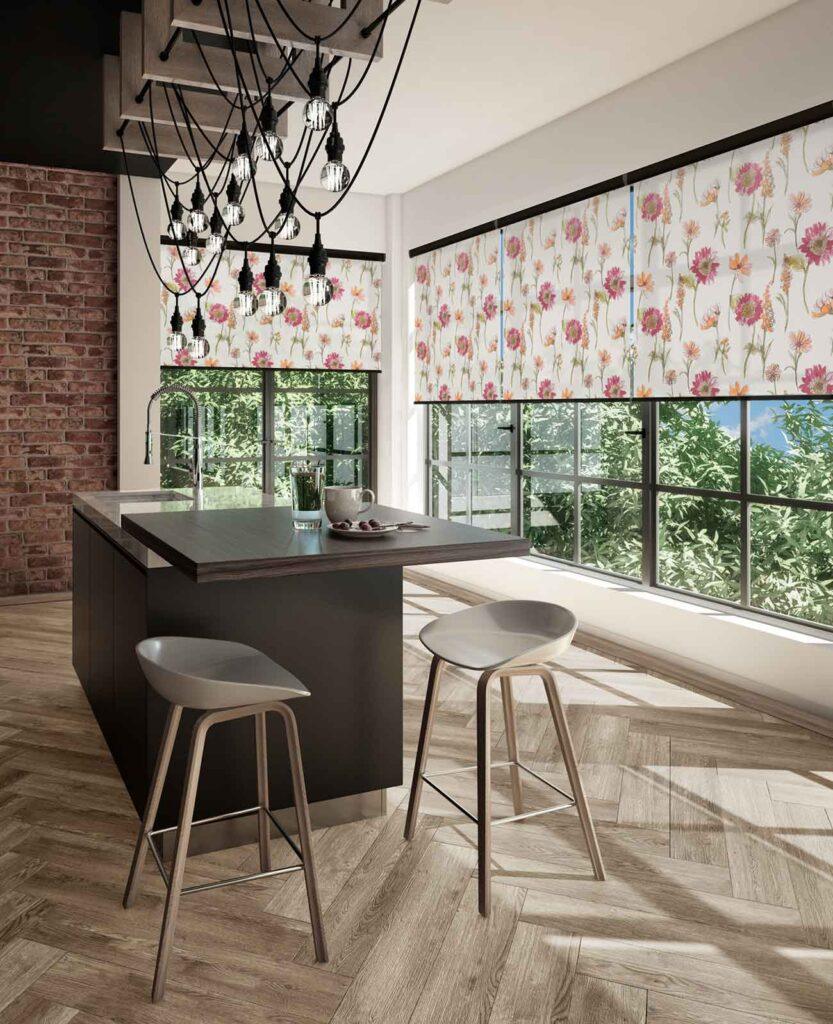
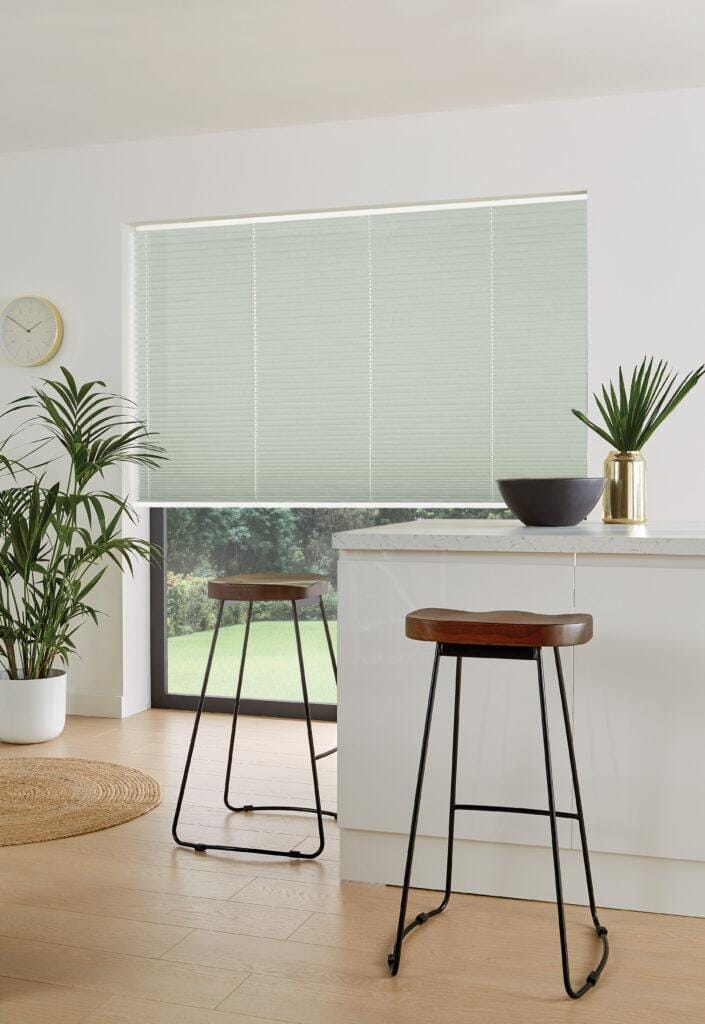
Most kitchens have at least one awkward window: the one over the sink, the one beside the hob, or the back door that is open half the day. A blind that looks right in a living room can stain, warp or simply get in the way in a kitchen. This guide covers what a kitchen does to a blind, which materials cope, how to treat each window in the room, and where softer fabrics still work.
What a kitchen does to a blind
A kitchen is the hardest room in the house on a blind. It is warm and humid, the air carries grease, water splashes from the sink, and the windows and doors are in constant use. Choosing a kitchen blind is mostly about choosing a material that copes with all of that, then a fixing that keeps the blind out of the way.
The working end or the dining end?
Most kitchens are really two rooms: a working end with the sink, the hob and the back door, and a softer end where people sit and eat. The working end needs blinds that cope with moisture and handling. The dining end can take the fabrics you would choose for a living room.
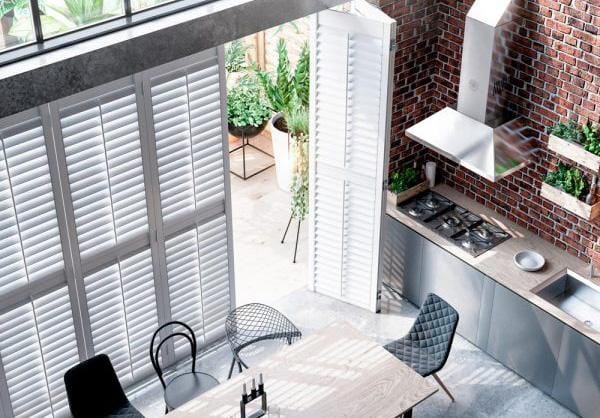
Moisture-resistant roller blinds, aluminium or faux wood Venetians and Perfect Fit framed blinds handle steam and splashes and stay clear of taps and handles. Aluminium slats take a damp wipe well, faux wood gives a timber look with better moisture resistance than real wood, and shutters in a waterproof material are a permanent option for a kitchen or utility room.
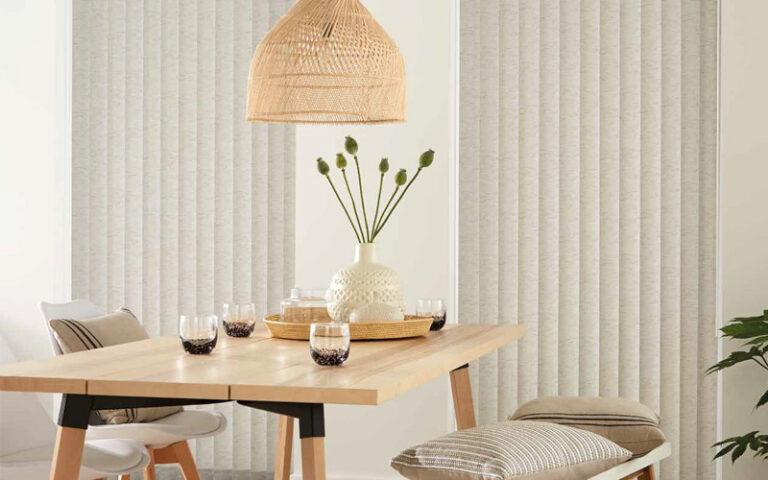
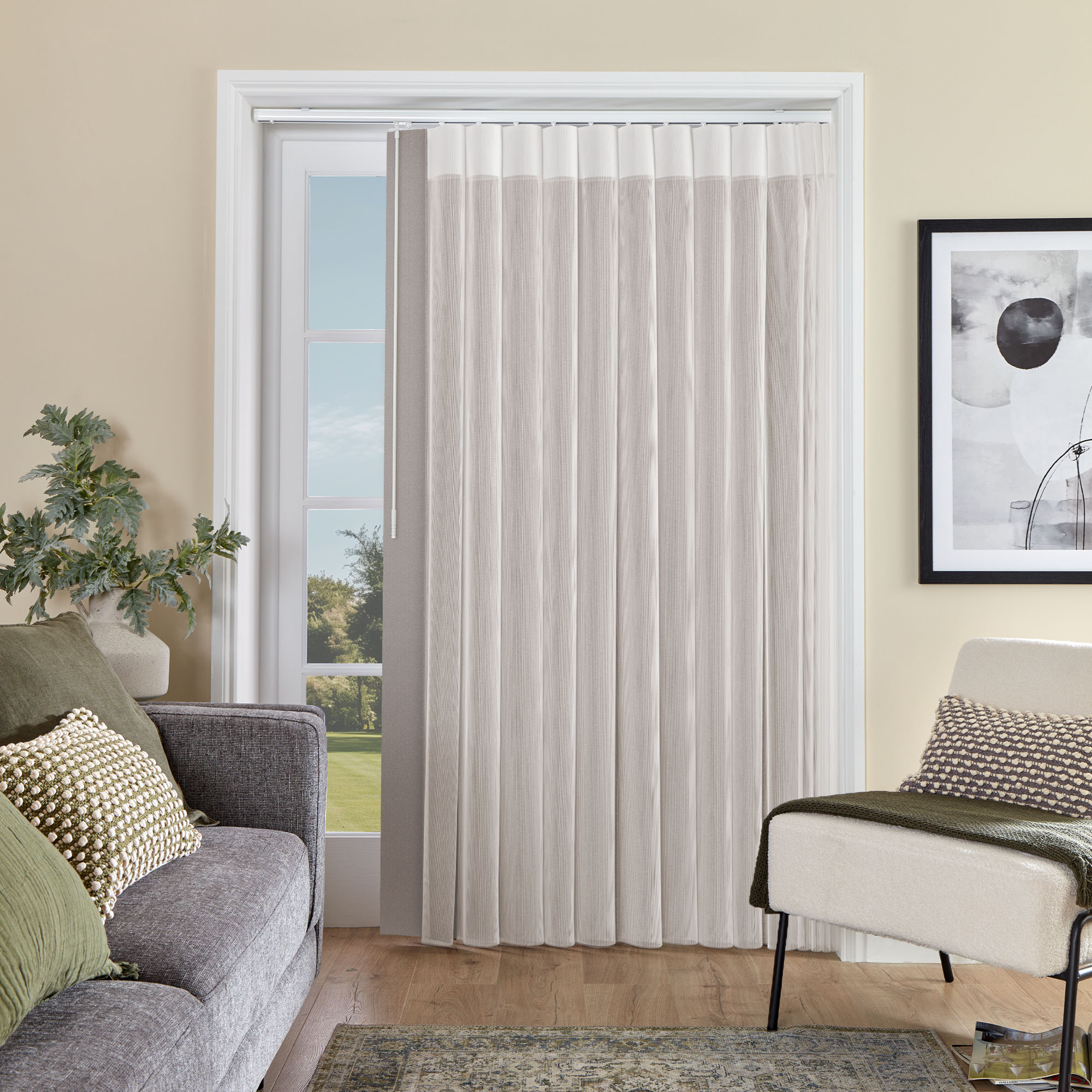
Away from the hob and the sink, a kitchen-diner can take vertical blinds across wide patio doors, or Roman blinds and curtains that bring warmth and colour into a room that is otherwise mostly glass, tiles and worktops.
The honest answer on fabric near the hob
Keep soft, loose fabric away from the hob. A Roman blind or a pair of curtains is a lovely thing in a kitchen-diner, but not beside a cooker or above a splashback where it will be splashed and heated every day. If the only window is right next to the cooker, choose a slatted aluminium or faux wood blind, or a roller in a moisture-resistant fabric, and keep the softer fabric for the other end of the room.
- Taps and handles can get in the way of a blind, so the fixing position for each window is worked out when it is measured.
- Tilt-and-turn windows need a blind that moves with the sash. A Perfect Fit blind sits in a frame that opens with the window, so nothing blocks the handle.
- Roof windows in a kitchen extension are a separate job. See the roof window and VELUX blinds guide, or the conservatory blinds guide for a fully glazed garden-room end.
Not sure what will work over your sink or on the back door? Book a free survey and we will tell you straight.
Book a free surveyThe blinds that work in a kitchen
These are the formats that hold up to a kitchen, and what each one is actually for.
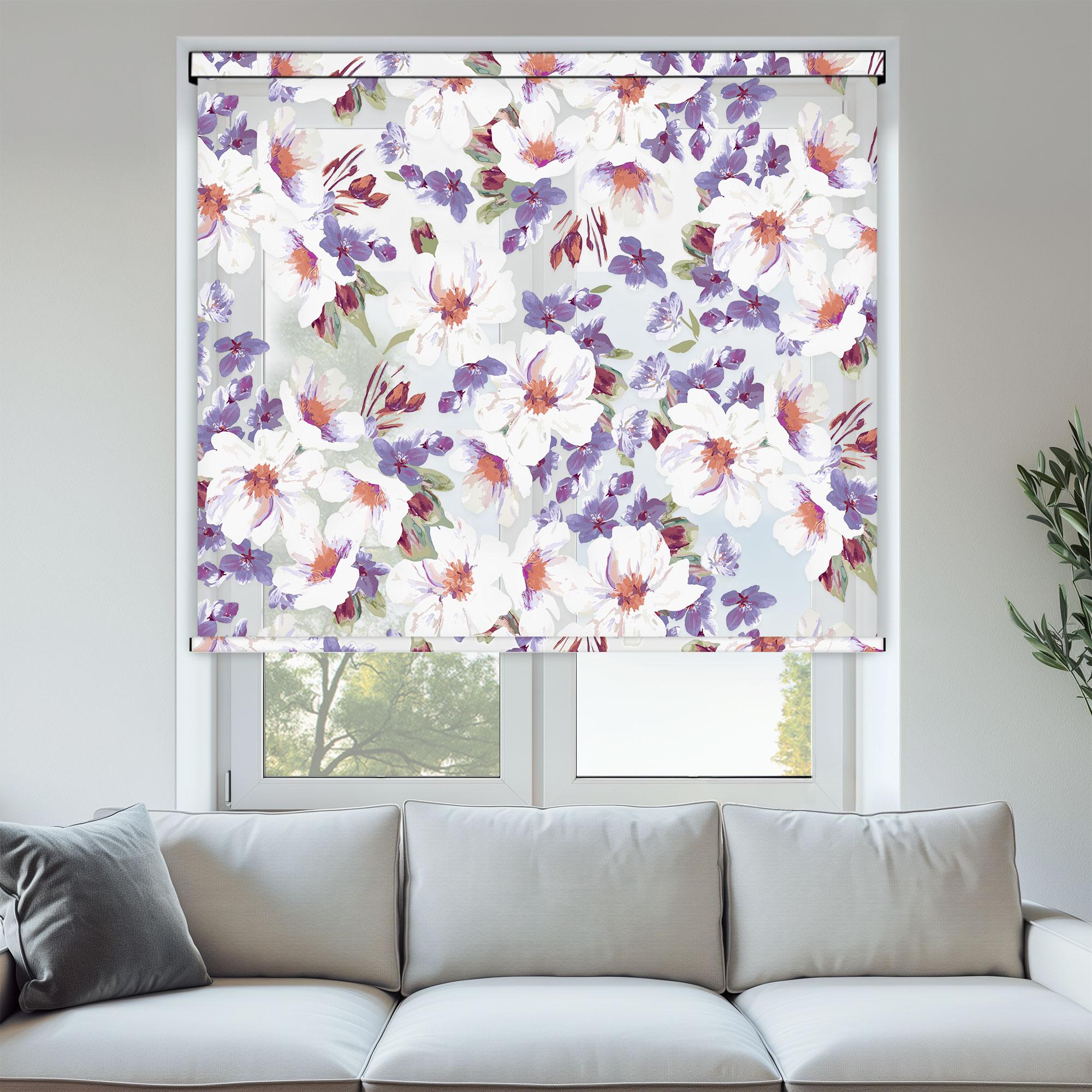
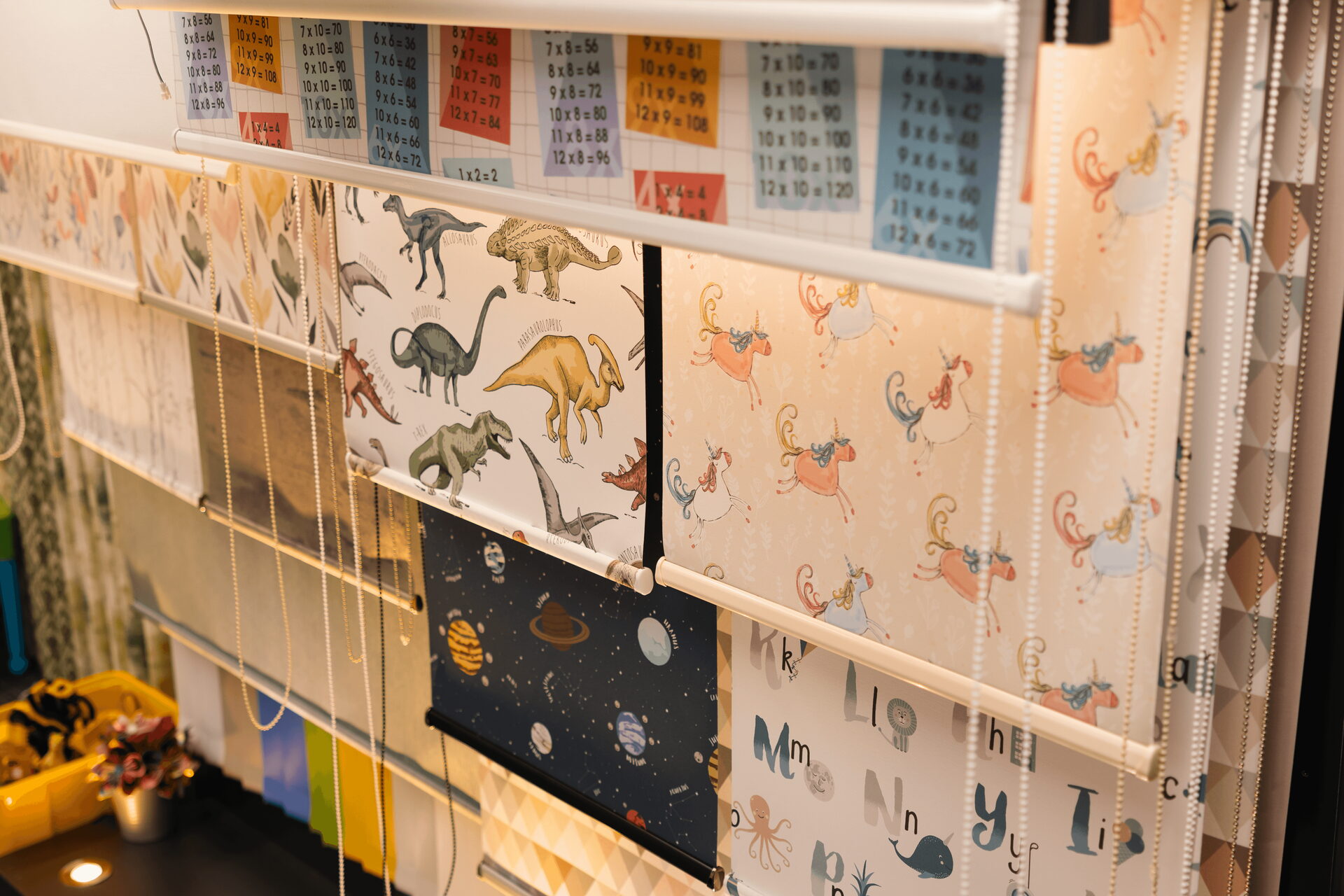
A single panel of fabric on a roller. Moisture-resistant fabrics are designed to handle everyday humidity better than standard fabrics, and a plain roller is easy to keep clean.
Best for everyday windowsSlats that tilt to control light and privacy without lifting the blind. Aluminium copes with condensation and wipes clean; faux wood gives a warmer look with better moisture resistance than real wood.
Best near the sinkA framed blind that clips into a uPVC window or door with no drilling. It moves with the sash when the window opens and has no loose cords or loops.
Best for doorsPleated or honeycomb fabric that folds up neatly. Translucent fabrics soften daylight while keeping privacy, a good fit for a kitchen window away from the hob.
Best for soft daylightLouvres that turn and draw right back, still the most practical answer for wide patio and sliding doors at the dining end of a kitchen-diner.
Best for patio doorsRemote, app or timer control for the window you cannot reach across the worktop. We fit Louvolite and Somfy systems.
Best for hard-to-reach windowsMatch the blind to each kitchen window
Every window in a kitchen has its own problem. This is the shortest route from the window to the right specification.
| The window | What it has to cope with | What usually works |
|---|---|---|
| Over the sink | Splashes, steam, hard to reach | Aluminium Venetian, moisture-resistant roller, or motorised |
| Beside the hob | Heat and grease | Aluminium or faux wood Venetian, or a wipeable roller |
| Back door or tilt-and-turn | Opening all day, handles | Perfect Fit, which moves with the sash |
| Patio or sliding doors | Wide span, people walking through | Vertical blinds, or Perfect Fit on each door panel |
| Dining end of a kitchen-diner | Glare, evening privacy, warmth | Roman blinds or made-to-measure curtains |
| Roof window in an extension | Sun from above, out of reach | Roof window blinds, often motorised |
Most kitchens end up with two or three specifications, one for the working end and another for the dining end. That is normal, and it is how the room is quoted.
Where curtains still work in a kitchen
Curtains belong at the dining end of a kitchen-diner or across a set of patio doors, not beside the hob or over the sink. There they bring softness, warmth and privacy to a room that is otherwise hard surfaces, and a blind behind them takes care of daytime glare so the curtains can simply frame the window.
Our handmade curtains are made to measure by our own seamstress team in Northern Ireland, with a choice of linings and heading styles. We bring fabric samples to a free home visit, so you can judge them in your own kitchen light, and a Roman or roller blind for the same window can be planned at the same time.
Measuring, fitting and keeping them clean
A kitchen is measured as one job rather than as a set of separate windows, so the working end and the dining end are specified together and the colours and fabrics sit well side by side.
Keeping them clean
Kitchen blinds collect more grease and moisture than blinds anywhere else in the house. Aluminium and faux wood slats take a wipe with a damp cloth. Most fabric blinds need regular dusting or a light vacuum with a brush attachment, then spot cleaning with a barely damp cloth, and pleated or cellular fabrics should never be soaked. Perfect Fit blinds lift out of their frames, which makes them easier to clean than most.
In a family kitchen, loose cords are worth designing out altogether. Perfect Fit blinds have no loose cords or loops, and motorised blinds remove the cord completely. Our guide to child and pet safe blinds covers the options.
Why choose Apex Elite Blinds for kitchen blinds
Apex Elite Blinds is a family-run blinds, shutters and awnings specialist established in 1993, manufacturing in Northern Ireland and serving Belfast, Lisburn, Lurgan, Bangor and across the province. A kitchen is one of the few rooms where the wrong blind shows itself within weeks, because it is handled, splashed and steamed every day. Getting the material and the fixing right at survey is most of the work.
Ready to sort the kitchen windows out? Explore our roller blinds and Venetian blinds, or book a free survey and we will handle the rest.